


Hamilton’s voter turnout rises slightly, but youth appear well behind
By Aysha Finlay, Mercy Chepkoech, Julia Bartley and Ronella Felizardo
A last minute rush and a range of initiatives from tiktoks to pop up events couldn’t get 2025 local body voters up to the high of 2019, but Hamilton City Council said every percentage increase counts.
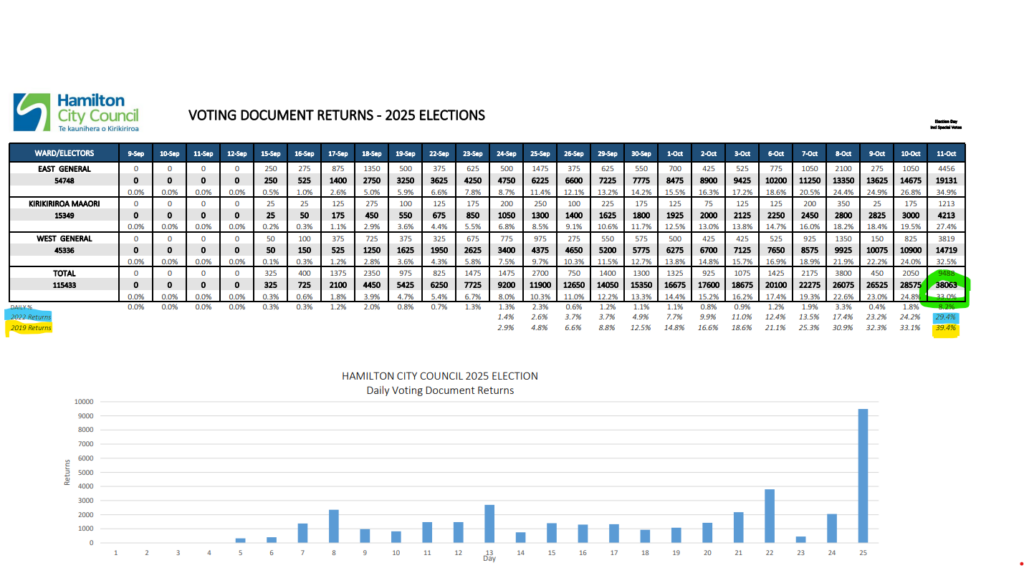
Despite Hamilton City Council undertaking a strong campaign of activities to encourage participation, voting in local body elections remains low. Only a third of eligible voters (33%) cast a ballot, and its worse for youth.
The final day of voting on Saturday October 11 saw a surge of participation, with 7.1% of the total vote coming in. It was the highest single-day total recorded during the entire voting period.
While overall turnout increased 3.6% on 2022 (29.4), it’s a long way from the 39% of 2019.
For youth voters, participation is even lower. A survey of 36 Wintec students in the week after the election saw only 6 had voted, or 16.5%, half the overall voter turnout.
Those who voted all had different reasons, with some going to the effort to research candidates and attend events. But many struggled with access to voting papers.
Student Gaby Jackson simply said “I can’t complain unless I’m part of the change”. Joey Sanders knew someone who was hosting an event for younger voters to meet candidates and said “there are issues that I think are important”.
Finn Alcock’s reason for voting was clear “I want to help out my family because we have a farming background, votes can affect farming and I’m a big advocate for voting”. Jade Perry, who also lives in a rural district said “I thought it was important to vote”.

However those who didn’t vote in the spot survey all shared similar thoughts and experiences including access to voting papers and time to understand the issues.
Stella Forrester said “I had just moved house, so my papers didn’t come. I also didn’t know who to vote and couldn’t see anyone who aligned with my values”. Vanya Derwin said “I lost my voting papers, and didn’t have the time to get it sorted” However, she said if she hadn’t lost her papers she would’ve voted in this years election
Simone Genner said “I really wanted to time to research the candidates to inform my vote but I am time poor, juggling study and work so couldn’t get this research done.” A majority also said their papers never arrived in their mailbox.
So what can be done to make voting easier? Jackson said “tailoring it more to first time voters would be more helpful. I didn’t know where to take my papers and I had to do a lot of my own research”. A few cited the volume of candidates and number of candidates as ‘overwhelming’ with one saying the signs were ‘annoying’. Forrester said “Simplified and easier to find information on politicians.”
All students surveyed agreed that online voting would be the most helpful.
Hamilton City Council announced a series of initiatives in September, aimed at increasing participation and removing barriers for voters. According to Hamilton City Council’s Deputy Electoral Officer, Amy Viggers, despite the modest increase of 3.6% from the 2022 turnout, they are still proud of the work behind this year’s election.
“Every percentage represents more people having their say, and that’s a win for local democracy.”
As well as strategies for youth, council tried to bring voting to the public. “We wanted to shift more to face to face engagement this meant meeting people where they already work, in community spaces, and at recreational facilities.”
While rain led to two cancellations, Viggers said “We saw strong public engagement with Votes and Vibes pop-up events.”
To attract younger voters, Viggers said they proactively engaged with all of Hamilton’s secondary schools and supported a student-led and voting drive in Rototuna. The team presented to more than 900 Year 13 students across eight schools, leading to 320 confirmed enrolments, and provided election resources to 11 secondary school including in Te Reo Maaori and any other relevant language.
Feedback from youth saw them tailoring information to reach younger audiences by creating 15 tiktoks and youth focused content across instagram with short engaging videos encouraging voting. Viggers said the team also “engaged with migrant youth, had information stands during Wintec and University of Waikato orientation weeks and responded to several youth and rangatahi-focused services with resources and information.”
While voter turnout in local body elections has decreased over the past 4 decades in New Zealand, one area of traditionally higher voter turnout is in provincial and rural districts. This year 43.6% of voters in rural areas cast a ballot compared to the lower metro areas.
In a Federated Farmers media release spokesperson Sandra Faulkner said the organisation had urged rural people to get involved in local decision making, both by standing as a candidate and by voting. Faulkner suggested rural and provincial residents may “better understand how decisions by local authorities affect their daily lives”.
While others in urban centres may disagree, in the Wintec spot survey, two of the six students who voted out of the sample of 36 were from rural areas, with both Finn Alcock and Jade Perry saying they felt their votes were important.

Viggers said the team will be reviewing the engagement from the Vote and Vibes event for future actions and will “take time to reflect on what worked well, explore new ideas for future elections, and identify anything we might do differently next time.”
The highest voter turnout in recent years for HCC was 2019 with just under 39%.