

Community, collectivity and curiosity – Creative Waikato
Where do the arts fit in a world fuelled by the buying and selling of commodities; do they remain relevant, what benefits do Creative Waikato offer the Waikato community?
Stepping into Creative Waikato’s unassuming entranceway at Garden Place, just down from the Hamilton Central Library; I’m met by Scott Granville one of Creative Waikato’s, Creative Development team members.
Scott is one of the team on the ground, identifying community needs, meeting face to face with art individuals and collectives to see how Creative Waikato can support or be a conduit to various resource.
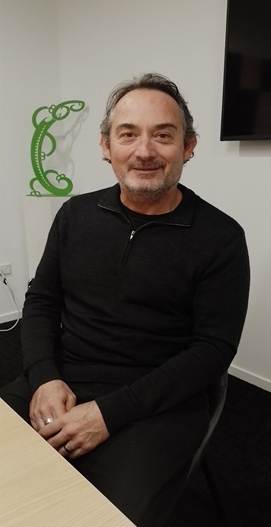
He’s dressed casually in a black sweatshirt, looking sharp with a goatee beard. He welcomes me warmly as we go to a meeting room to sit down and chat. The vibe is relaxed, the dialogue flows under the bright neon lighting.
Scott is Hamilton born and bred, well-travelled and well educated. Describing himself as a wanderer he earned a scholarship to the USA through his love of football, has taught English and travelled extensively in Asia.
He also has an interest in film making through screen writing and producing and is an accomplished author, having had various books published.
But the roots are very firmly here in the Waikato, having collaborated with Jeremy Mayall for much of the last twenty years.
Granville started contracting at Creative Waikato over three years ago, then transitioned to part time work, then a fixed-term role where he said he finds balance and joy from being part of the team.
Scott has been working on a long term project with Creative Waikato which aims to shine a spotlight on the diverse range of artists and creatives in our region.
“The project’s called Creativity Lives in Waikato and has been in three separate iterations.”
The first iteration focused on individual artists from all of the districts in the Waikato region, the second small collectives of artists that had a particular theme, the third finished this week; working with Waikato District Council on ten organizations and how they use creativity supporting the local community.
Scott said it had a broad range of groups, and included, “the Sculpture Park at the Waitakaruru Arboretum, Tuakau Youth Centre,Onewhero Society of Performing Arts, the Storehouse in Pookeno, which is like a collection, there’s a men’s shed, a community garden and the Meremere Puutaiao Society”
It’s a group he describes as “just wonderfully diverse.”
The process involved Scott interviewing a number of people within these organisations, talking to them about what they’re doing to serve the community.”
As to why the arts are important to a community, Scott is clear, “We want people to feel like their voices are being heard, then we can create a healthy community or society where respect and well-being become highly valued.”
If a football analogy was applied to Creative Waikato Scott would be the centre forward, up front scoring lots of goals.
One of his teammates is Alexis Holmes, the Operations Manager at Creative Waikato. She directs me to a café’ style stool. Blonde hair, bespectacled with a nice smile; she has an air of supreme confidence in what she is doing and what Creative Waikato are trying to achieve.
Alexis is a problem solver who makes sure that all the departments within Creative Waikato are working as they should be, systems are up to date; that the team are getting the resources they need to perform their roles efficiently.

Alexis grew up in rural Waikato and was introduced to performing arts at a young age, through this experience she has learnt the importance of social connection. She says, “it’s all about the people you meet, really fascinating networks.”
Building relationships is key “I was doing a show at the time. I met the CEO who was here at the time and we had a great working relationship during a show.”
Alexis said she saw that Creative Waikato were recruiting but the position wasn’t clear as they were assessing the potential of the role as well as the candidates “so I looked at that and thought, give it a nudge.”
When Covid 19 hit the Waikato, everything ground to a halt overnight, Alexis was taken by surprise, “I think as an organisation, it was pretty crazy really, it was one of those things that you go, hey, we’re going to have to move. What are we doing? Because work from home didn’t exist.”
When the first lockdown happened; they packed up all of the team’s equipment or whatever they required, and delivered them to their homes.
Alexis acted as a liaison with artists, staff and the Creative Waikato team; checking in on groups like the Raglan Old School Arts Centre to see if they were OK.
Adapting quickly to using ZOOM was important for meetings and also incorporated mornings and afternoon catchups to keep the Creative Waikato team connected.
For a lot of people in the Waikato region, Covid lockdowns meant their jobs were gone so Creative Waikato spent a lot of time on wellbeing initiatives to keep people and communities feeling valued.
Alexis remembered Jeremy creating a project called Kotahitanga, a project to combat online racism which was gaining momentum at the time. Alexis felt that due to Covid lockdowns, “a lot of people seemed to lose their minds a bit.”
For Alexis equity of access to the arts is important. Creative Waikato has created eleven 3-hour workshops in their Artreach suite which also includes other programmes such as Elevate and Pakihi Toi, designed for artists and community groups that are constrained by distance, time or finance. She tells me, “I’m loving that direction that we’ve taken, we’re getting a lot of good feedback.”
Alexis is a big Warriors fan and I think if she was in a league team she would be at fullback; keeping an eye on everything and making sure there’s no gaps on the field of play for unforeseen surprises.
My final interview is with the CEO(Chief Executive Officer), Dr Jeremy Mayall. I’m greeted warmly by Jeremy; a big man, bespectacled and with a long fully-grown beard. He looks more like a front row prop than the CEO of an arts organisation.

It is a cold morning in Kirikiriroa he offers me a cup of tea and we sit down to talk in a meeting room surrounded by white walls and a sculpture of a tuatara.
Jeremy comes from a large family in Kirikiriroa. Being the eldest of six siblings, I think it is safe to say that he learned how to negotiate and lead from a young age.
He’s a multi -talented polymath in the creative arts, which has included playing in bands, composing music and working as a DJ. For him curiosity is a constant, finding new things and how they can be implemented into the Waikato arts culture.
A professional in the arts sector for the last twenty years; Jeremy also has the perspective from an academic point of view. This makes him the perfect person for navigation through the commercial and creative sectors.
Jeremy achieved his Doctorate by doing a Major in Music at the University of Waikato, before taking his family to Dunedin for two years as the Mozart Fellowship composer in residence at the University of Otago.
Returning to Hamilton he became academic and research leader at the School of Media Arts at WINTEC; before becoming interim CEO at Creative Waikato, eventually leading to this permanent role.
Jeremy feels that, “the mission of Creative Waikato is so deeply entwined with what I would like to do. It was a really interesting pairing where you’re providing strategic advice around the sector, but also advocating for its importance.”
And adds, “important from both a community perspective and from a professional artist perspective, from having the research and being able to say it’s not just a thing that I feel, here’s the data and all of the evidence.”
When asked about the arts in times of stress Jeremy believes that, “artists bring people together. They give us a way to process emotions and ideas in a way that’s really helpful, they unite us.”
He points to history, the way that we’ve built meaning, built connection and built understanding through sharing, especially the sharing of stories.”
Recently he directed and composed a piece for the opening of the BNZ Theatre in Hamilton Central and says, “I had the pleasure of being commissioned to write the opening show, so it was a two-hour original work, celebrating creativity.”

Jeremy worked with a team of collaborators on the story, and ended up having four hundred and fifty performers on stage. It was clearly an exhilarating and exhausting time, “I’m still kind of buzzing from that; it’s crazy, it was massive.”
If Jeremy was playing rugby union he’d be switching between front row prop and first five eight conducting everything on the field of play.
People/Tangata are at the centre of everything at Creative Waikato, evidence shows us that the arts give us a common way to share grief and challenge, they give us the ability to step outside ourselves and see that we are not alone. That we are interconnected with the past, the present and the future. They also prove there is economic benefit gained from the arts.
Stepping out onto the concrete path of Garden Place I remember Alexis’s reply when I asked about the importance of the arts, “humans have always needed social connection, social cohesion, it’s like food and water.”
Editors note: This article is a feature profile based on interviews with Creative Waikato staff about their programmes and initiatives. It may not represent the views and experiences of the wider arts community.
Paul J Michael is a student on the New Zealand Diploma in Journalism